The lab in the time of ShPL
Steve took Shared Parental Leave (ShPL) for 3 months with his baby daughter Isla, and the MetaLab are grateful for Marco stepping into the breach and keeping everyone on the rails!
Steve took Shared Parental Leave (ShPL) for 3 months with his baby daughter Isla, and the MetaLab are grateful for Marco stepping into the breach and keeping everyone on the rails!
Currently one month in to parental leave with our daughter. Wasn’t sure whether to post about this but then I learnt than in the UK only 2% (two percent!) of Dads take it up: https://t.co/dxDedzf5eI 1/N pic.twitter.com/qJLfWiBKVu
— Steve Fleming (@smfleming) June 10, 2022
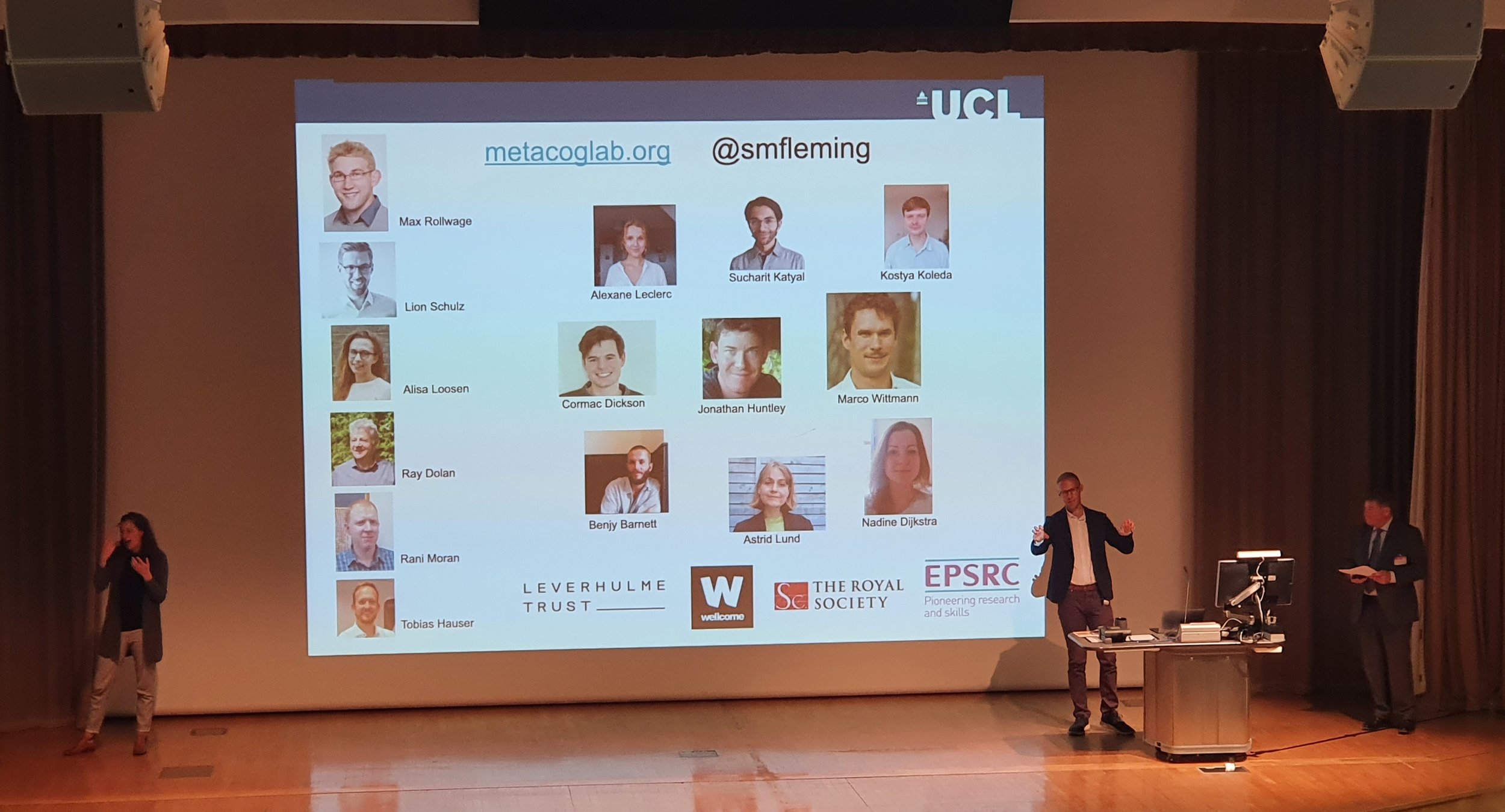
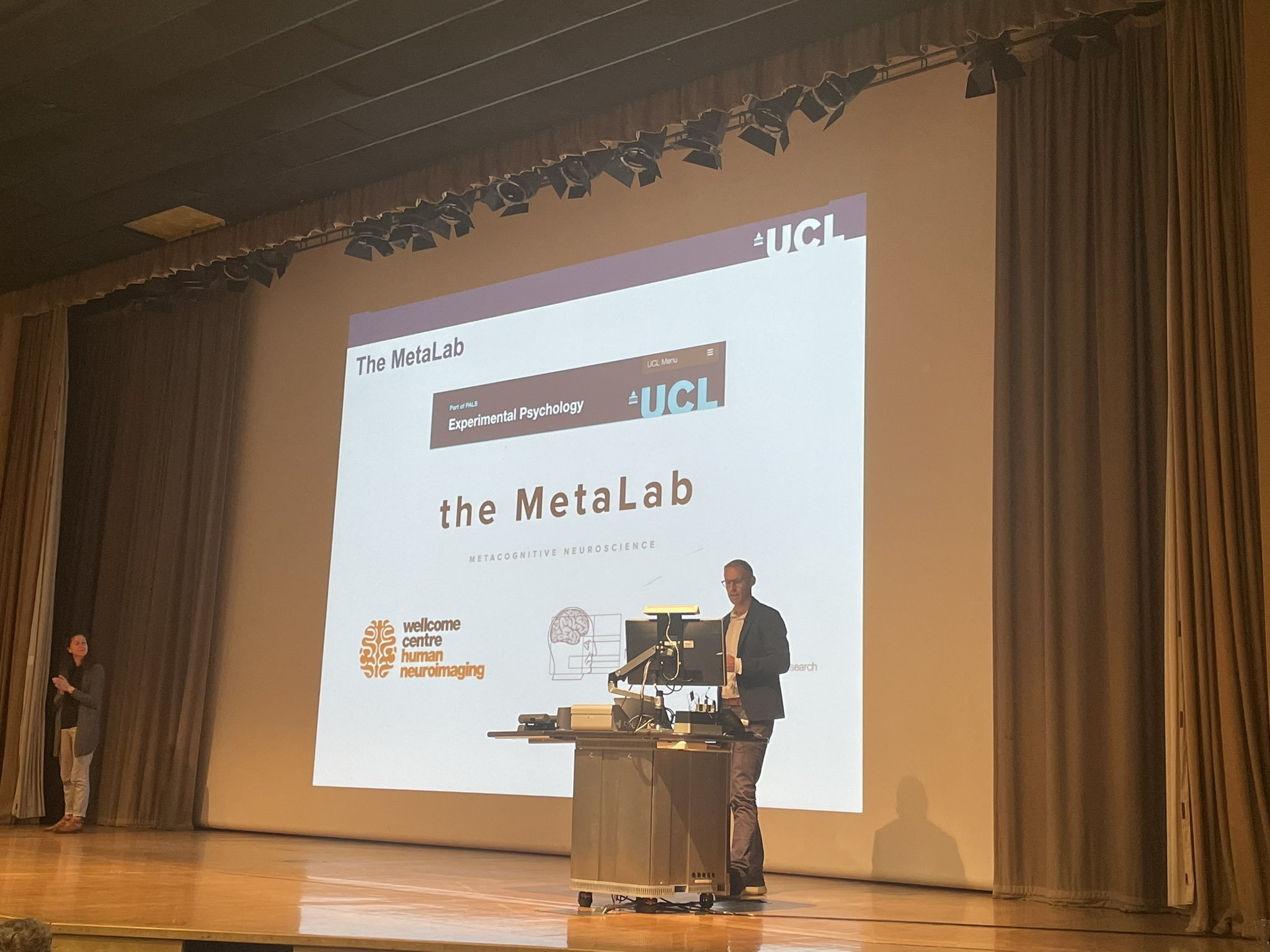
Steve gave one of the plenary lectures at the UCL Neuroscience Symposium - the first after the pandemic, and entitled “Reconnecting UCL Neuroscience: From Cells to Society”. It was a great event, with some stunning talks from across the faculty, including brilliant student prize talks.
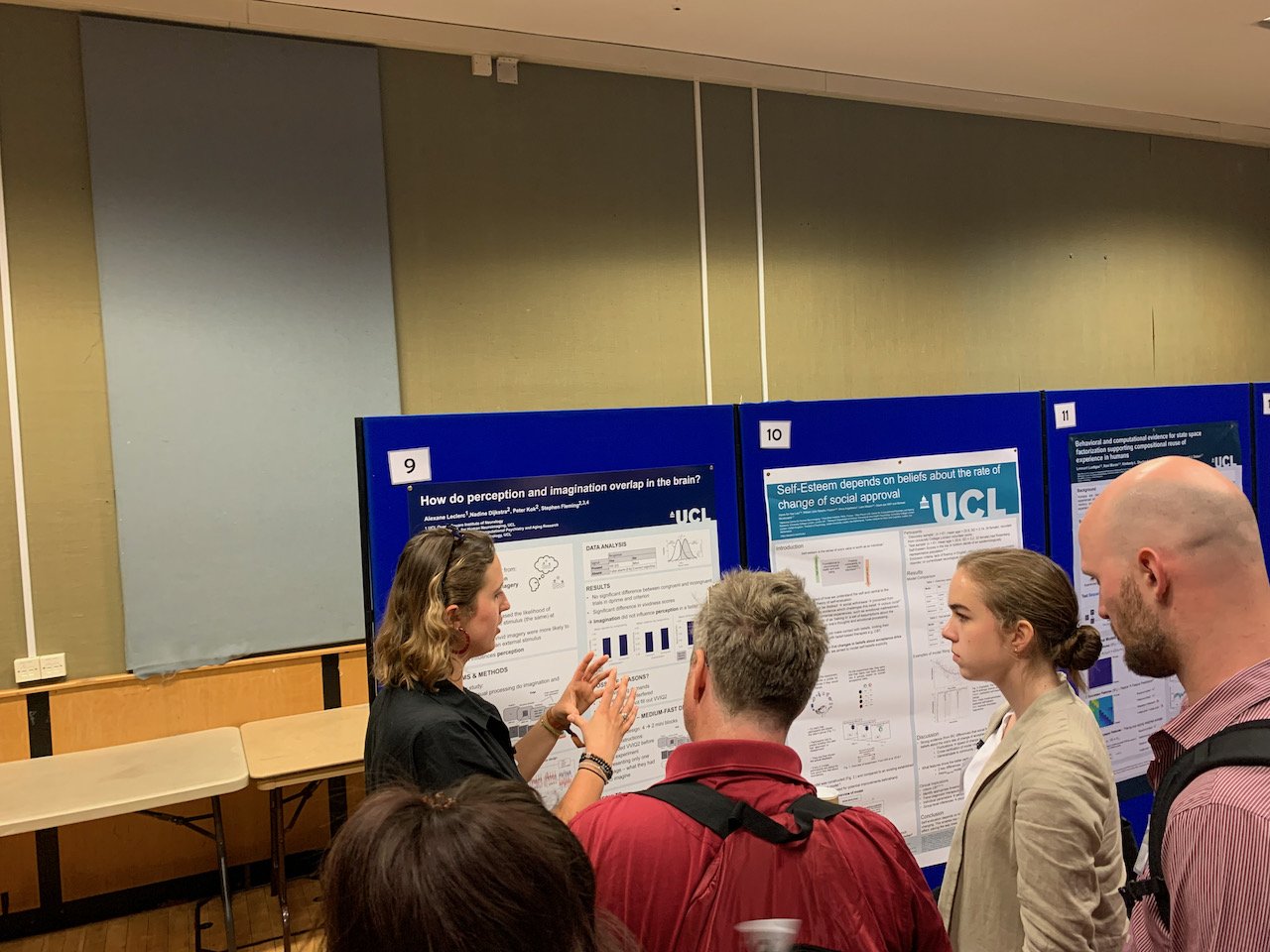
Alexane presented her poster on her Masters project with Nadine, and got some very useful feedback - well done Alexane!
Nadine and Matan worked together to reanalyse some existing data in the lab, to ask whether prefrontal signals linked to stimulus visibility (and by implication, visual awareness) are confounded by decision confidence. The short answer is yes - but they also provide a novel method for controlling for this confound. More details in the (tag team!) twitter thread, and in the paper which is now in press at Journal of Neuroscience. Congratulations Nadine and Matan!
New preprint from the dream team that is @nadine_dijkstra and @mazormatan on dissociating prefrontal signals related to confidence and visibility. And they have inaugurated the tag-team Twitter thread! 🥳 https://t.co/xgW3v8ntbE
— Steve Fleming (@smfleming) June 2, 2021
Matan’s paper, “Efficient search termination without task experience” is now out in Journal of Experimental Psychology: General. Matan used a novel one-trial many-subjects design to show that people are already efficient (fast) at recognising the absence of a target in an array of distractors without any prior experience. This shows that they have implicit second-order knowledge about visual search performance (they know that if a target had been present, they would have seen it quickly) before they even engage with a task

A paper on potential mechanisms for perceptual reality monitoring (how we tell what is reality, and what is imagined) is now out in Neuroscience & Biobehavioral Reviews, led by Nadine Dijkstra and together with Peter Kok. Congratulations Nadine!
Excited to share that our review 'Perceptual reality monitoring: neural mechanisms dissociating imagination from reality' is now published! With @PeterKokNeuro & @smfleming https://t.co/zur3ByHk9g
— Nadine Dijkstra (@nadine_dijkstra) February 3, 2022
Steve was interviewed by Sam Harris for the Making Sense podcast - they talked about the relationship between self-awareness and intelligence, self-monitoring, theory of mind, deception and self-deception, metacognitive failures, dementia and lots more. Listen again here (subscription required to access the full episode):

Sucharit Katyal has joined the MetaLab as a postdoc working at the Max Planck Centre for Computational Psychiatry, in collaboration with Steve, Ray Dolan and Quentin Huys. He plans to focus on developing new tools for metacognitive training, and the impact of such training on mental health. Welcome Sucharit!
Nadine’s latest research on perceptual reality monitoring was covered in a New York Times article by David Brooks: https://www.nytimes.com/2021/09/02/opinion/brain-reality-imagination.html

Another fun interview about metacognition and Know Thyself, this time with Ginger Campbell on her brilliant BrainScience podcast
Steve had another fun discussion with Paul Middlebrooks on his BrainInspired podcast - this time all about metacognition and his recent book, Know Thyself
This summer we had a few new people starting in the lab. Benjy Barnett is starting his PhD with us as part of the Leverhulme Ecological Brain DTP. Cormac Dickson is starting his PhD on the IMPRS COMP2PSYCH programme, after completing his Masters thesis in the lab. And Marco Wittmann is joining us as a postdoc from the University of Oxford, where he was working with Matthew Rushworth.
Welcome to all!


In a new theoretical paper led by Nadim Atiya, we use a biologically-plausible model of decision uncertainty to show that shifts in metacognition are associated with disturbances in the interaction between decision-making and higher-order uncertainty-monitoring networks. This provides a first step towards a dynamical systems perspective on metacognition - one that models continuous interactions between different levels of the network. Excitingly, this approach also potentially enables inferences about uncertainty modulation (and, in turn, these facets of metacognition) from fits to first-order performance data alone. We related our model’s uncertainty modulation to individual differences in psychopathology (reanalysing existing data from the lab), and show that it can offer an implicit, low-dimensional marker of metacognitive (dys)function.

Tricia and Marion’s “How local and global metacognition shape mental health” has now been published in Biological Psychiatry. In this paper, we review current behavioral and neural metrics of local metacognition and address the neurocognitive underpinnings of global metacognition uncovered by recent studies. We then outline a theoretical framework in which higher hierarchical levels of metacognition may help identify the role of maladaptive metacognitive evaluation in mental health conditions.

Xiao Hu’s paper “A Bayesian inference model for metamemory” has now been published in Psychological Review. In this paper, we introduce a Bayesian inference model for metamemory (BIM) which provides a theoretical and computational framework for the metamemory monitoring process. We show that the predictions of this model are consistent with previous studies on metamemory.

Steve’s trade book about metacognition, “Know Thyself”, is now published! More information can be found here.
It was positively reviewed in Science here: https://science.sciencemag.org/content/372/6541/470.summary
and was the feature of a New Scientist cover story! https://www.newscientist.com/article/mg25033332-300-how-to-boost-your-self-awareness-and-make-better-decisions/


I am very excited to share our latest paper “Mistaking imagination for reality: congruent mental imagery leads to more liberal perceptual detection” with @mazormatan, @PeterKokNeuro, @smfleming! 🧵https://t.co/4WTTDi2NDi
— Nadine Dijkstra (@nadine_dijkstra) April 19, 2021
Nadine Dijkstra’s paper “Mistaking imagination for reality: Congruent mental imagery leads to more liberal perceptual detection” has now been published in Cognition. In a series of 3 experiments, we investigated whether people might confuse imagery for perception. We found that imagining a stimulus makes you more likely to report seeing it - and that this effect was both independent of expectation, and stimulus-specific.
See Nadine’s twitter thread for more details!

Steve and Hakwan Lau took part in an episode of Paul Middlebrooks’ BrainInspired podcast on consciousness - listen again here!
Steve was interviewed for Hugo Rifkind’s Times Radio show on Saturday morning about metacognition, self-awareness, AI and lots more - listen again here:

The MetaLab is glad to welcome Yuena Zheng (MSc in Neuroscience) and Cormac Dickson (MSc in Psychological Sciences) who will be doing their Masters projects with us this year. Yuena will be focusing how different regions in frontal and parietal cortex work together to support decision confidence formation, together with Dan Bang. Cormac will be working on expanding out the higher-order state space model of awareness to investigate temporal dynamics.